
The Delivery Week You Can't Explain: Why Records Beat Memory Every Time
If you are a dispatch operator in Lagos, you already know what your normal week looks like. Not one or two jobs. Many jobs. Different vendors. Different riders. Pickups in the morning. Drop-offs in the afternoon. Extra stops that were not in the initial plan.
Phone calls from vendors. Phone calls from riders. Phone calls from customers. Prices agreed on the fly. Address changes in the middle of the trip. Small questions all day that turn into big confusion by Friday. And that is the real problem.
Too much is happening at once for you to hold the full week in their head and the pressure gets heavier because more people are selling online. More customers want same-day delivery. More orders mean more jobs to account for.
Which means more pickups. More drop-offs. More riders to track. More price agreements to remember. And Lagos does not make any of this clean. Addresses are often unclear. Traffic changes everything. Gate men slow handovers. Customers do not always pick up.
A simple job can become five calls, one delay and one argument. So when the phone rings, the problem is rarely only one delivery. It is the whole week behind it. A vendor calls. “Boss, you did five jobs for me last week. Why is the money not adding up?”
You remember the week. You remember the traffic around Ikeja. The long wait in Computer Village. The rain near Lekki. The rider who called from Yaba. But you do not remember the exact price for each job. You do not remember the distance. You do not remember which rider took which package.
You do not remember the pickup time, drop-off time or who received the item. So you go for the easiest and best option at that moment which is guessing. And once you start guessing, you have already lost the argument. It is not your effort that is in question. It is your proof. Trust me, your week can be real and still be impossible to prove.
The Week You Did Everything Right
You completed the jobs. Your riders moved the packages. Customers received their packages. You paid for fuel, handled calls and solved problems on the road. But when the vendor asks for a clear breakdown, all you have is a WhatsApp chat, a few bank alerts and a tired memory.
One job was “around ₦8,000”. Another was “the one that went to Ajah”. You think a different rider handled the phone delivery, but you are not fully sure. The vendor is not listening to your effort. They are looking for proof. And you cannot show it.
This is how small arguments become big losses. A vendor removes ₦2,000 from the payment because the price was not recorded. A rider says he delivered the parcel, but there is no photo. A customer says nobody received the package, but there is no name or OTP.
You spend an hour checking old messages. That hour is not free. It is time you could have used to take another job, speak to a better client or rest before the next busy day.

Memory Is Not A Business System
It is not that you are careless, boss. Lagos delivery is too busy for memory to carry everything. You are handling calls, riders, traffic, fuel, vendors, customers and sudden address changes at the same time. By Friday, the details have mixed together. Memory keeps the story.
It loses the evidence. Delivery volume in Lagos keeps growing, and every new order is another job you will later need to account for. More online orders mean more delivery jobs. More delivery jobs mean more prices, riders, routes and customer handovers to track.
If your system is only your head and a WhatsApp chat, every busy week creates a new gap. And gaps are where disputes grow and from dispute, losses.

The Operators Who Do Not Lose These Arguments
Some dispatch operators face the same Lagos traffic you face. They deal with the same fuel costs. Their riders also get delayed, miss calls and struggle to find addresses. Yet when a vendor challenges a job, they do not start searching through old messages.
They open a record. That is the difference. They are not better because they remember more. They are better because they do not depend on memory. Their business leaves a clear trail after every delivery.
This is the part many operators avoid. You may believe records are only for big logistics companies in Lagos. They are not. You may think your dispatch company is too small for proper records. That is exactly why you need them.
A small mistake can take a large part of your weekly profit. A missed price. A missing rider's name. An unconfirmed receiver. One forgotten delivery can turn a profitable week into a week you cannot explain.

The Hard Truth
A vendor will not pay based on how tired you were. They will not pay because your rider spent three hours in traffic. They will not trust your explanation simply because you have worked with them before. They will ask one question: “Can you show me?”
If the answer is no, your reputation carries the loss. This matters even more when you handle valuable goods. Phone sellers, laptop repair shops, fashion vendors and pharma businesses need more than a rider with a bike.
They need verified dispatch riders, clear handovers and a delivery record they can trust. Nigeria’s new digital postcode system is targeting about ₦80 billion in delivery losses linked to poor addressing and failed deliveries. The country is paying attention to delivery losses. Your vendors are paying attention too.

What A Proper Delivery Record Contains
Here is the change. Record every job. Not only the difficult jobs. Not only expensive jobs. Every job. The price must be agreed and locked before pickup. The rider assigned to the job must be known.
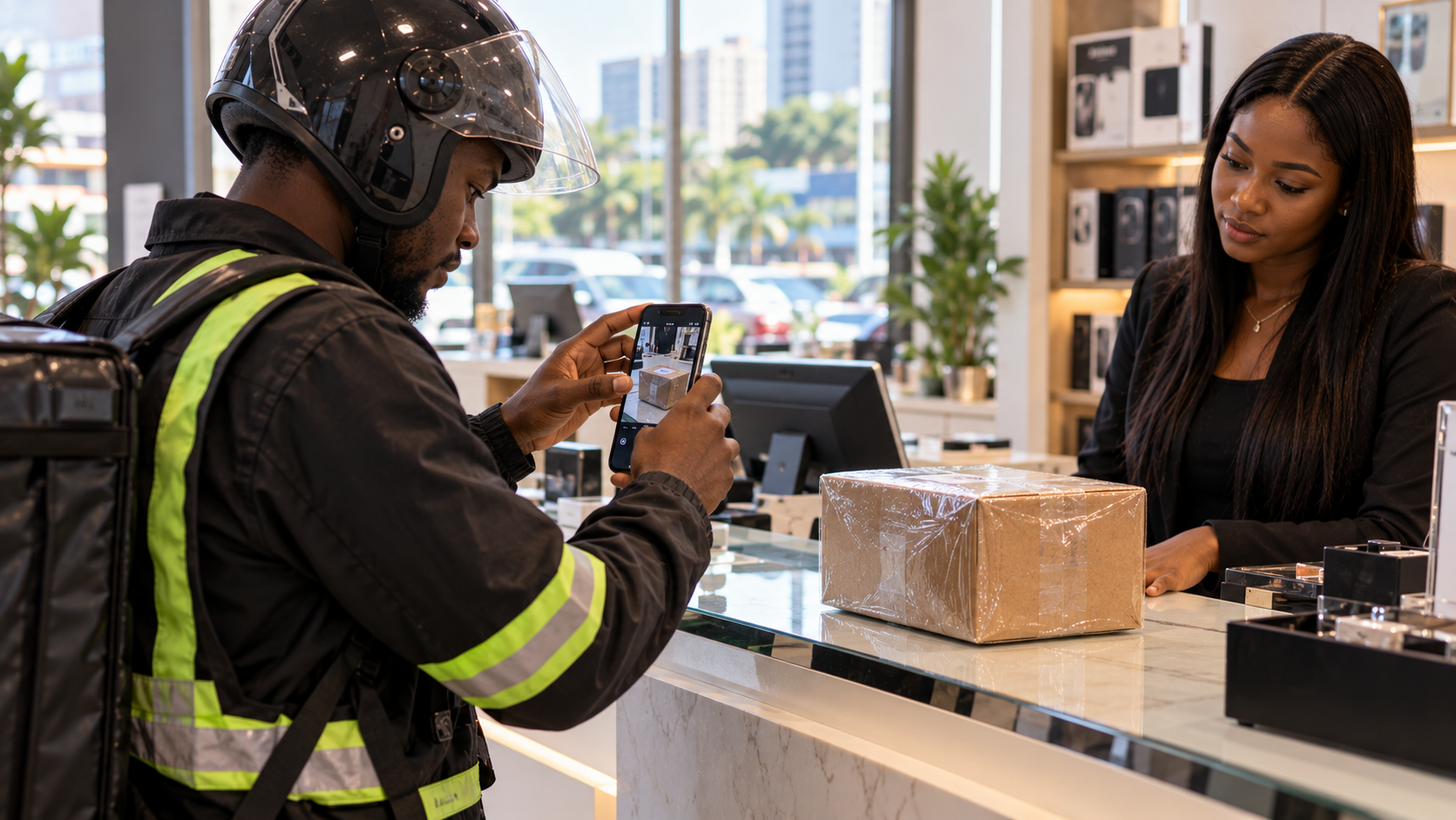
A photo must be taken to show the package at pickup. Another photo must also be taken to show the package at drop-off. The recipient must confirm delivery with an OTP. The date and time must stay attached to the job permanently. Six small details. Every job. No exceptions. That is the difference between a memory and a record.
The Week You Can Finally Explain
The vendor calls again. “Boss, you did five jobs for me last week. Why is the money not adding up?” This time, you do not argue. You open the record. Job one: pickup photo, rider name, agreed price and drop-off time. Job two: route, price and recipient OTP. Job three: delivery photo and exact timestamp.
Everything is there. The argument ends in 30 seconds. No long voice note. No scrolling through old chats. No guessing. No discount forced on you because the details are missing. This is what a trackable delivery in Lagos should feel like.It also changes how vendors see your business.
When an online vendor can see the job status, confirm the rider and receive proof of delivery, trust grows. When the vendor trusts your process, they are more comfortable sending phones, laptops, jewelery, fashion orders and other valuable goods through you. That is where better jobs come from. Not from shouting that you are reliable. From making reliability visible.

Build Records, Not Stories
With GoSendAm, dispatch operators can be part of a delivery process built around real records. Vendors can find verified dispatch companies for same-day delivery service in Lagos. Jobs can carry agreed pricing, real-time tracking, pickup and drop-off photos, recipient OTP confirmation and permanent timestamps.

That gives your business something stronger than a promise. It gives you evidence. You cannot argue with a week you can prove. Build that record today!
